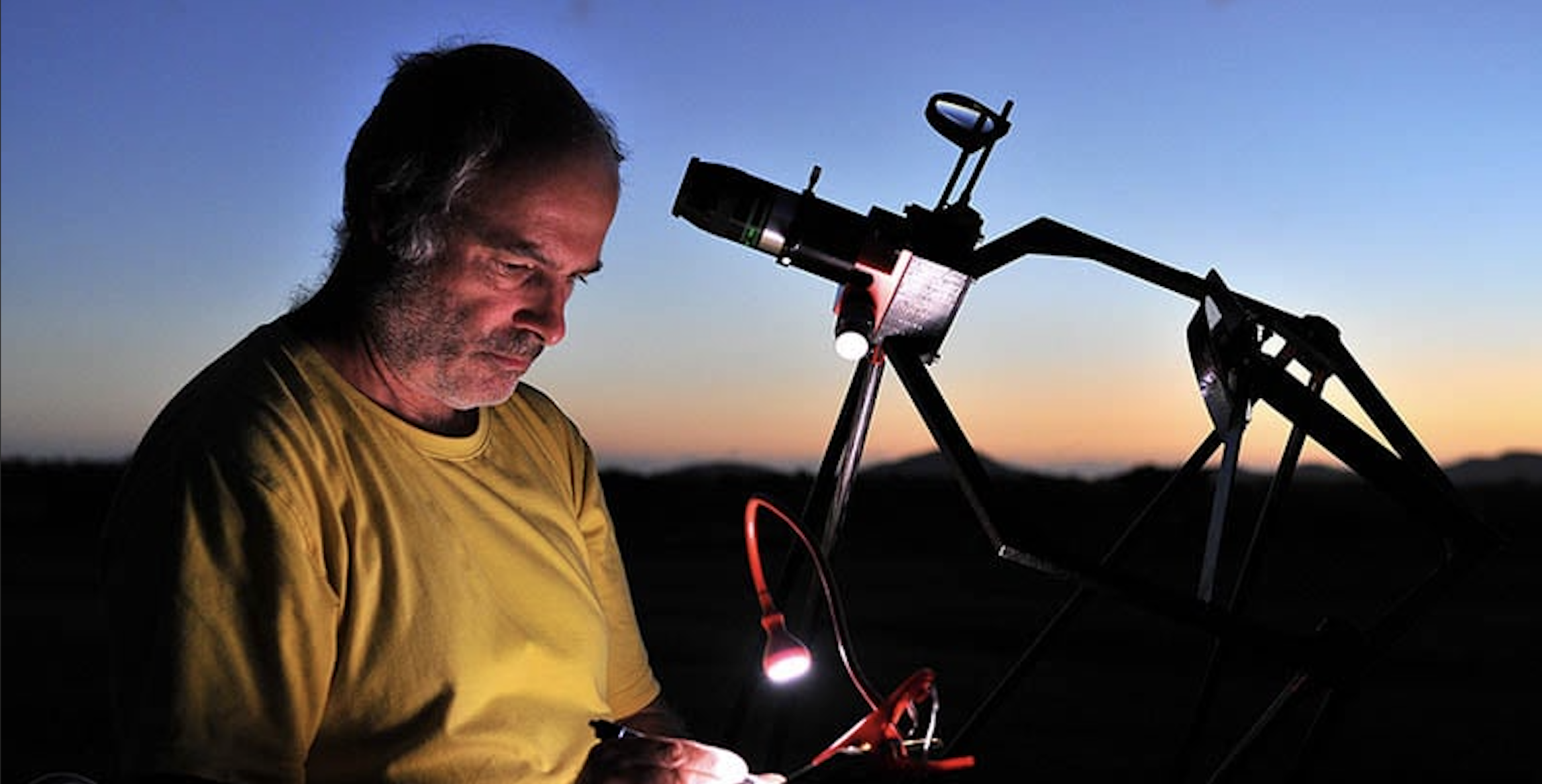
A quick introduction?
I wear size 43.
What made you want to start astro-drawing?
From my first instrumental observations with a T115, I was surprised to see so much on deep sky and planetary objects, as was the case with the immense surprise of discovering the Ring Nebula or the stunning perception of Martian geography. And from there, to keep a trace, a testimony of this astonishing “discovery” as suggested by a few rare chapters at the end of books dedicated to astronomical practice. And then very quickly, there was a real pleasure in throwing myself body and soul into this discipline that had fallen into disuse, definitively excluding photo acquisition, too constraining in my eyes in terms of equipment, cost, and frantic race to technical innovations. The feeling of playing amateur astronomy like the ancients. And with experience, realizing that the visual transcribed by a personal evocation in drawing offered an unprecedented, infinite potential. This by varying subjects, but also with this jubilant quest to push the three parameters of observation to the maximum of what was possible for me, namely the triptych sky-instrument-observer. What adventures lived to enjoy the most beautiful skies on the planet! What pleasure to have the opportunity to observe in exceptional instruments and learn to use them at best! And what amazement to see how drawing improves observation, forces one to “see better”, or more precisely to see these faint lights and tenuous contrasts differently.
How do you draw? (tools, supports, telescope, eyepieces…)
My drawing tools never leave me: a clipboard that serves as a board and storage for sheets of paper, smooth white paper 200g/m², a few graphite pencils from HB to 6B, two blending stumps (one small hard and one large), pencil sharpener and sandpaper for the stumps, an eraser and especially a gooseneck lamp whose brightness is adjustable. Two colored pencils for nebulae: one purple and one green, which when inverted will respectively give green and red. I have another kit dedicated to planetary with a whole range of colored pencils and shades of gray.
The instruments used are multiple and range from the naked eye to the largest telescope I’ve had the privilege to access, the 120cm one at OHP. We can mention the amateur instrumental progression since I joined my club MAGNITUDE78 and its C8, then noticing the difference that a friend’s C10 brings, then seizing the rare opportunity at the time to acquire a 400 imported from the USA. There were our first RAPs with the emotion of putting our eye in the first 600s and this kind of Holy Grail of going up to Col de Restefond and meeting “pillars” of the amateur instrumental renewal, benefiting from their expertise and learning at their side. There was the apotheosis of the inauguration of David’s T1000 on this extraordinary and totally mastered instrument, offering extraordinary, unimaginable visions.
We imagined at the club to design and build our own instruments, meeting the need to observe under ultimate skies, and therefore to equip ourselves with compact, light and robust instruments without sacrificing performance. From this was born the adventure of the Strock 250 whose number of copies made is countless, inspired by this innovative concept. It was an opportunity to learn mirror polishing. Armed with these skills, other instruments based on the same concept have been successfully made, such as the M78 club’s T600 or its antipodean cousin made during my stay in New Caledonia with the ACA club. For my part, I polished the mirror and designed my T400 travel telescope, which weighs 15kg. Together, we scoured the most beautiful skies on the planet, a rare privilege and acute pleasure.
Let’s not forget solar observation with its specific instrumentation in H alpha or with coronagraph, many friends invite me to share their sophisticated instruments with them, the most remarkable being Serge Deconihout’s 43.5cm reflecto-refractor.
What are your best memories or your favorite drawings?
They are countless and I would have a hard time classifying them! In no particular order:
- Certainly the observation at the top of Mauna Kea at 4200m altitude with my T400, the feeling of an exceptional and rare observation under a crazy sky.
- All these adventures in preserved deserts, the Atacama of course, but also the Sahara with the Tuaregs, Namibia and its nocturnal fauna, the Australian bush, the absolute tranquility of the South Pacific and these entire nights in New Caledonia or more simply on a small pontoon of the Fakarava lagoon contemplating and drawing the Milky Way. Closer and very rewarding, our beautiful trips to La Palma or even closer, those of Saint Véran or Restefond.
- The opportunities to observe in prestigious historical instruments such as the Lille refractor, Arago’s in Paris, the OHP telescope.
- All observations at David’s T1000 are extraordinary.
- I have a special attention for the observation and drawing of total Solar eclipses, a most remarkable discipline that requires preparation. It’s always the occasion for memorable adventurous journeys and the most acute emotions in front of one of the most powerful spectacles that nature offers us. I have the happiness of having experienced 10 of them, and await the following ones with jubilation!
What is the most complicated object you’ve had to draw? And which one would you like to do or redo?
The difficulties encountered in making a drawing are multiple. There are therefore many different configurations:
- Observing a vast complex object requiring exceptional conditions that are too rarely present. As an example, I would cite the Rosette, whose formidable potential can be judged, but it is so diaphanous and tenuous that ultimate conditions are required. I have many drawing attempts, but never satisfactory enough to finalize them. It took me several years to gather optimal conditions and devote two entire nights to it with the T460 in the mountains. Very hard work!
- On the opposite side, there are objects that are simple, but so ghostly that you have to come back to them again and again, spending long hours at the eyepiece to attempt a fleeting detection. The Abell catalog provides such challenges.
- Planetary drawing is difficult because it requires a lot of precision. This is the case of the Moon in high resolution, with its infinite details and subtle shades of gray, good management of shadows and lights. Venus is very low in contrast and it is very delicate to perceive cloud streaks. Mars, Jupiter abound with details that must be transcribed as best as possible in a restricted time due to their rapid rotation.
- Drawings of total Solar eclipses are a subject in their own right, as the phenomenon is rapid, complex, unpredictable in appearance and one must tame the emotion that overwhelms us in these counted moments. To do this, I practice beforehand within the allotted time from evocative images. There is a great deal of rapid sketching and memorization work, then transcription on paper.
- As for the most complex drawings, I have mainly two which are all composites made over several nights, several consecutive years and which represent for each dozens of cumulative hours on the subject. These are the Orion Nebula where A3 formats were used, and that of the Milky Way in its entirety, observed with the naked eye or sometimes with binoculars, spread over 3 years, observed from the Tropic of Capricorn to that of Cancer. The drawing takes place on 4 A3 formats placed end to end, or 168cm in total length.
Do you have any advice for someone who wants to start drawing?
First of all, have fun!!!! Don’t be in drudgery, in hardship. You must feel the irresistible desire to pick up pencils, it’s not a necessity or an obligation.
Be fully aware that the main interest of drawing is to improve observation, drawing becoming only the tool to achieve this. From this, there is no obligation of result, regardless of whether one judges it successful or not, but all the better if it brings satisfaction.
It’s the best archive of your visual observations, whatever the final quality of the drawing, or sketch, or even the simple outline.
From this, I have the deep feeling that I have not observed with application if I do not draw.
Can you send me a drawing you would like to share and/or a link to a blog or website?
http://www.astrosurf.com/magnitude78/serge/index.html
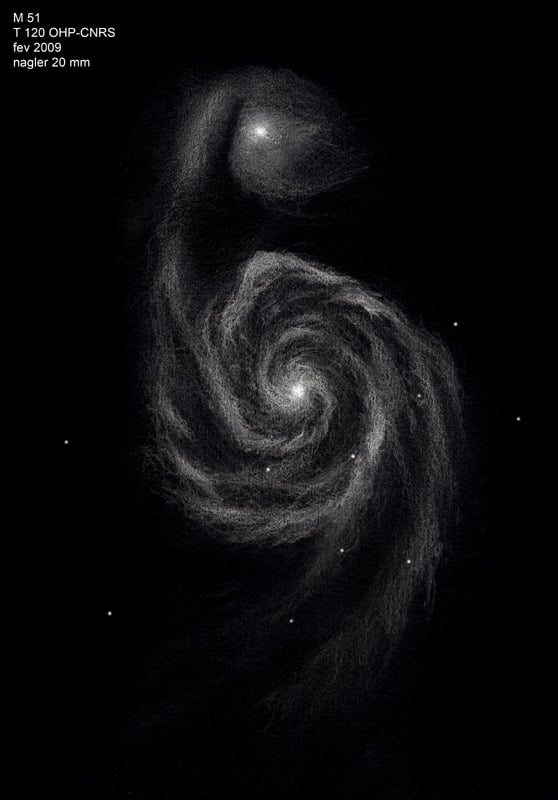
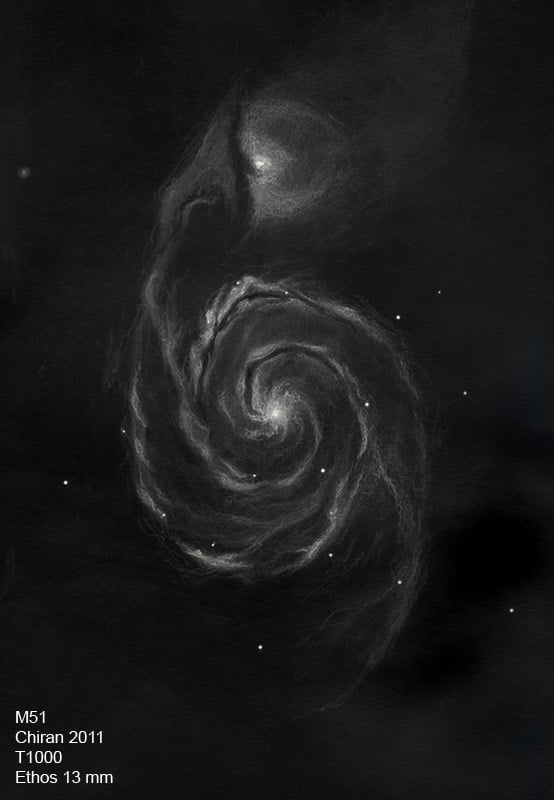
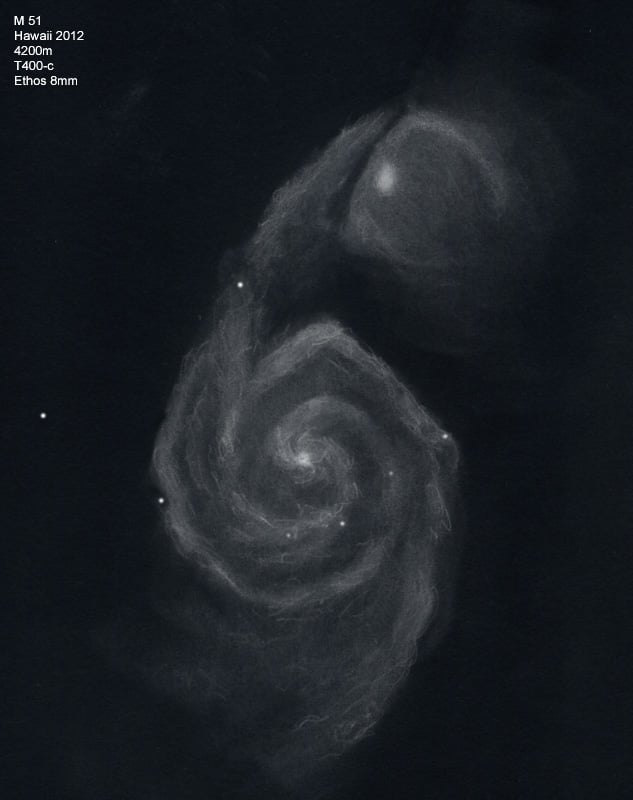
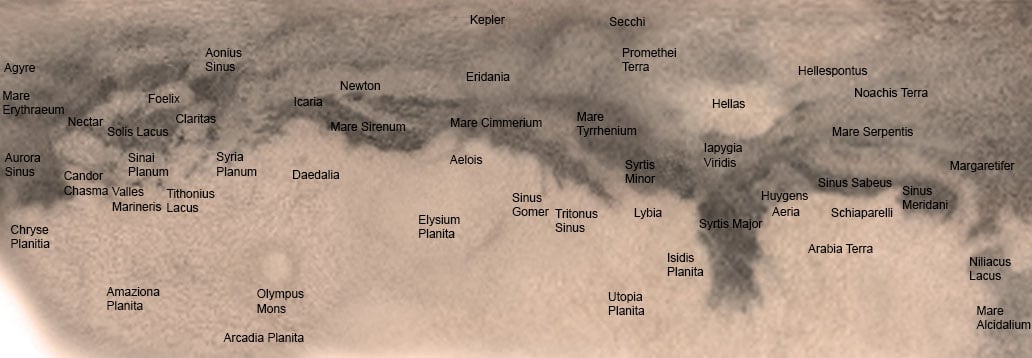
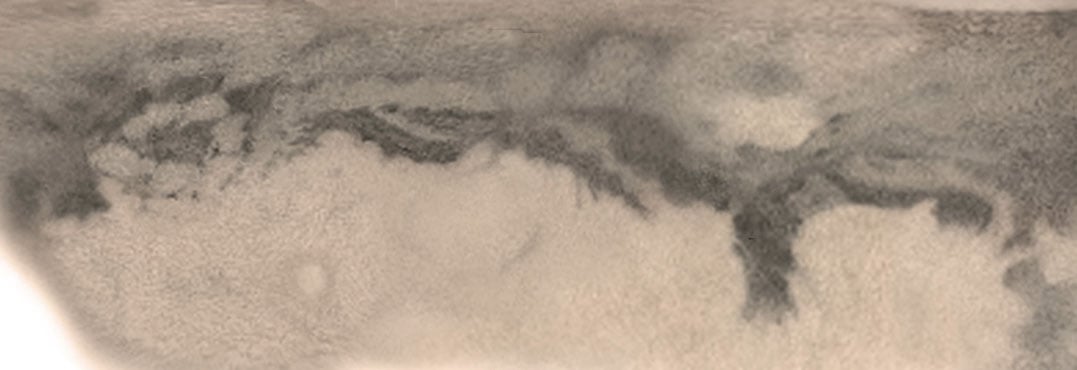
The Martian planisphere from 2020.
Serge Vieillard