Want to observe the Moon, planets, nebulae, galaxies…? Read this before you buy
Short answer: to avoid it ending up in the garage, pick a telescope that’s light (under 5kg), assembles in under 5 minutes with no complicated manual, and that you actually understand. This guide compares three 150mm telescopes (Skywatcher Heritage, Bresser Messier, Smallest) to help you spot the one you’ll actually take outside.
You look up at the night sky and think: “It would be amazing to have a telescope to see the Moon up close, the Andromeda galaxy, the rings of Saturn!” But you don’t know anything about astronomy, and you’re afraid of buying something complicated that will end up gathering dust in the garage.
Good news: you don’t need to be an astronomer to enjoy a telescope.
In this guide, I’ll explain simply (no technical terms) why some telescopes end up unused, and how to choose a model you’ll actually take outside. We’ll compare two concrete telescopes: a popular classic and an ultra-practical, next-generation model.
Why 80% of telescopes end up in the garage
Before we get into specific models:
Most people who buy a telescope use it 2 or 3 times, then it ends up in the garage.
Why? Not because the sky isn’t interesting. It’s because the telescope is:
- Too heavy to bring outside
- Too complicated to set up
- Too bulky to store
- Too frustrating to use
The result? You tell yourself “I’ll take it out this weekend,” and you never do.
So before comparing models, here’s what actually matters:
1. Will you actually take it outside?
A telescope that weighs 10kg and needs 20 minutes to set up? You won’t take it out. Period.
2. Is it simple to use?
If you need to read a 50-page manual to understand how it works, you’ll give up.
3. Where does it live when you’re not using it?
If it takes up all the space in your living room or garage, it’s going to get on your nerves fast.
4. Does it zoom in enough to see something cool?
Yes, because the whole point is to see the Moon in detail and the rings of Saturn.
5. Do you understand how it works?
Or is it a mysterious “black box” you’re afraid to touch?
That’s it. The rest (technical jargon, specs, etc.) doesn’t matter for now.
A real comparison: three telescopes that show you the same thing
We’ll compare three telescopes that show exactly the same thing (same magnifying power). The difference? You’ll actually use one of them; the others will end up in the garage.
The Flextube Heritage 150P: the “classic” telescope

This is a very popular model, recommended everywhere on forums. It has a good reputation and isn’t expensive (~€300-400).
But here’s what nobody tells you:
Problem #1: It’s heavy and bulky
- 7 kilos (imagine carrying it on a bike or a hike)
- 37cm wide x 41cm tall, even when “folded”
- Hard to fit in a backpack
- Hard to bring on vacation (unless you have a huge trunk)
- You’ll need a big special carrying bag (~€50)
Problem #2: The focuser is bad
This is the #1 complaint from people who own this telescope.
The problem:
- The eyepiece holder is low quality
- It has play (it wobbles in every direction)
- Impossible to get a precise focus, especially at high magnification
- If you add a slightly heavy accessory (a good eyepiece), it gets even worse
In practice: You spend 5 minutes trying to get a sharp image, and the moment you touch the telescope, everything shifts. Frustrating.
On forums, people say: “the focuser is junk.” Many people rig up special tape to try to improve it.
Problem #3: You have to adjust it (collimation) constantly
Because of the sliding tubes that fold up, the mirrors go out of alignment.
The problem:
- You have to check the mirror alignment very often
- If it’s misaligned, the image is blurry
- For a beginner who doesn’t know how to fix it, this is a nightmare
In practice: You take out your telescope, and surprise: the image is blurry. You have to adjust everything before observing. You’re already fed up.
Problem #4: You don’t understand how it works
The telescope arrives already assembled in a tube. You can’t see what’s inside. You don’t understand why it works.
Result:
- If something goes out of adjustment, you don’t know what to do
- You’re afraid to break it
- You don’t dare customize it
- It’s a mysterious “black box”
Real final price: €300 + €100 tripod + €50 bag = €450
Plus a bonus: hours of frustration with focusing and adjustments.
The Bresser N 150/750 Messier Hexafoc EXOS-1: the “serious-looking” telescope

This is the telescope you see on forums, with people saying “now that’s a real telescope.” It has a big mount that looks professional (~€400-500).
But here’s the reality:
Problem #1: It’s even heavier and bulkier
- Weight: ~10-12 kilos with the mount (impossible on a bike or a hike!)
- Requires a huge tripod with lots of screws and adjustments
- Impossible to transport without a car and plenty of space
- Takes up a massive amount of room in the garage (tube + giant tripod)
In practice: It’s so heavy that you NEVER take it out. It stays in the garage.
Problem #2: The “equatorial mount” (= hell for beginners)
You’re told it’s great because it “tracks the stars automatically.” But nobody mentions that you have to:
- Find Polaris (good luck if you don’t already know it)
- Do the “polar alignment” (point the tripod precisely north)
- Set the angle based on your latitude (do you know your latitude?)
- Balance the tube with counterweights (otherwise it tips over)
- Understand the two axes of rotation (right ascension + declination = a headache)
The result? You spend 30 minutes setting the thing up before you even see anything. And if you get the settings wrong, it doesn’t work.
In practice: It’s so complicated that you give up after 2 attempts.
Problem #3: It’s fragile and expensive
- The mount goes out of adjustment easily
- If you tighten too hard, you break parts
- Spare parts are expensive
- You’re afraid to break it every time you handle it
Price: ~€500 (and you’ll never use it)
The Smallest: the telescope designed so you’ll actually use it
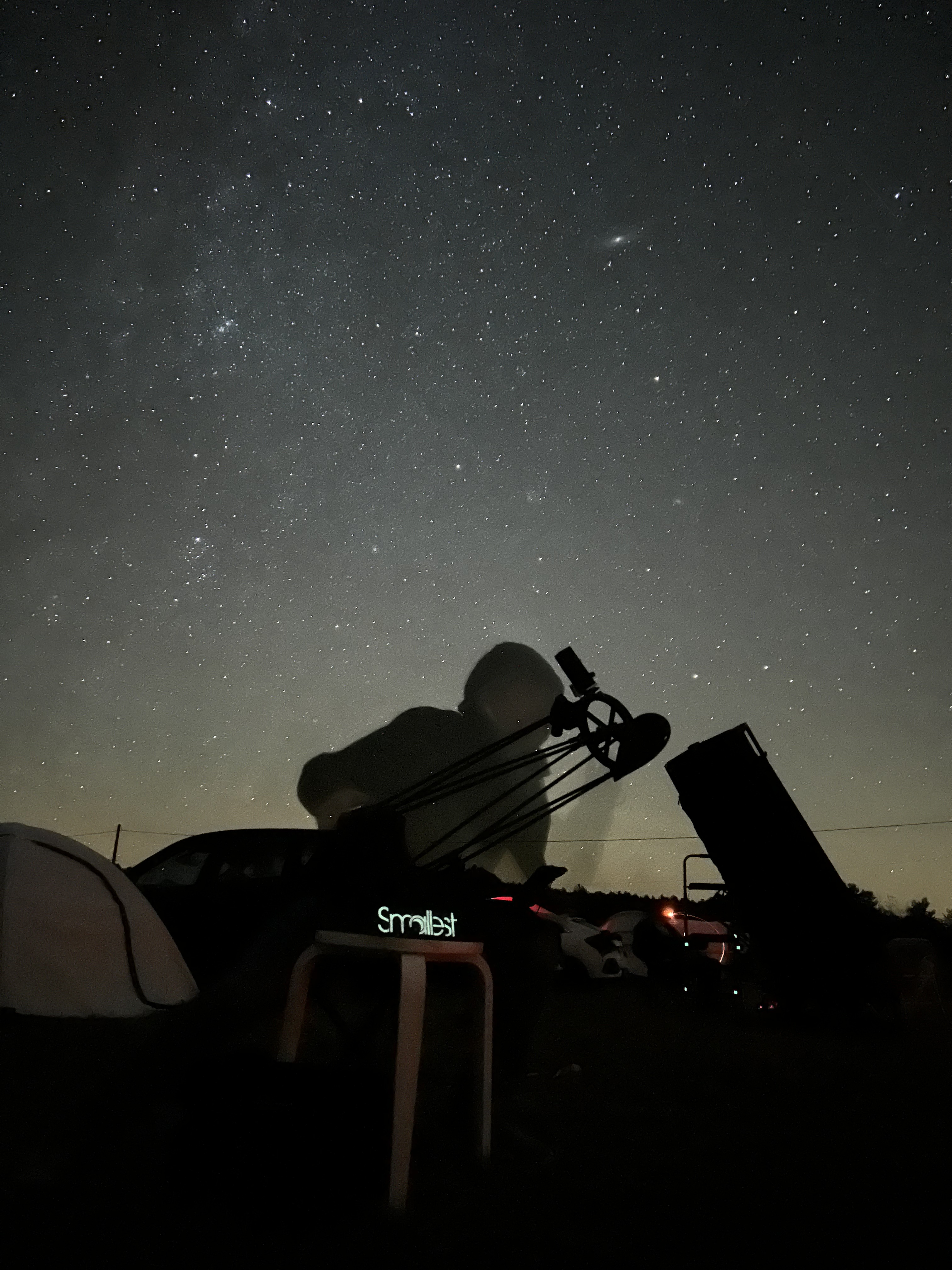
The Smallest is a telescope created by a guy (me) who got tired of seeing people buy telescopes and never take them out. The idea: solve every problem of the classic telescope.
Difference #1: You can really take it everywhere
Weight: 4 kilos (like a bag of groceries) Folded size: 25cm x 25cm x 20cm (fits in a normal backpack)
What does that actually change?
- Going away for the weekend? You bring it.
- Going on vacation? It fits in the car with no problem.
- Flying? It goes in your cabin bag.
- Going to the mountains? It fits in your backpack.
Result: You use it 10 times more often. Because it’s there, available, easy to carry.
Difference #2: You assemble it in 4 minutes (and it teaches you how it works)
Unlike the classic telescope, which arrives already assembled, the Smallest goes together like a puzzle.
But that’s a good thing! Because:
-
You see how it’s built: you put the mirrors, structure, and tubes in place. You UNDERSTAND how it works.
-
You’re no longer afraid: if something goes out of adjustment, you know what to do. It’s no longer a mystery box.
-
It’s like assembling a simple IKEA piece of furniture: every part has its logical place. No need to be an engineer.
-
After 2-3 times, you assemble it without thinking, in 4 minutes flat.
The real advantage: you become self-sufficient. You master your telescope instead of just putting up with it.
Bonus: No need to fully disassemble it every time!
Here’s the great part: you can leave certain parts assembled.
For example:
- You leave the mirrors in place in their structure
- You store everything in its bag (still compact)
- Next time you go out: 30 seconds to set up instead of 4 minutes
In practice: you’re in your garden on a weeknight, you see the sky is clear. You take out the bag, clip the tubes together, place it on its base, and you’re ready!
With classic telescopes? You have to get out the big bag, open it, set up the tripod or the table… Too much hassle. You put it off till tomorrow. And you never do it.
Difference #3: You observe standing up, comfortably
No table to find, no awkward position. You place the telescope on the ground and observe standing up.
Simple. Efficient. Comfortable.
Even your kids can use it with no problem.
Difference #4: Made in France (and customizable)
- 3D printed with an ultra-resistant plastic
- Primary and secondary cage connected with carbon fiber tubes
- You choose the color
- You can add accessories over time
- If you already have parts from an old telescope, we can adapt them
Price: €550 (structure only) or €790 (complete kit, ready to observe)
Yes, it’s a bit more expensive than the classic telescope. But you’ll actually use it.
Full comparison table
| Criteria | Flextube Heritage 150P | Bresser Messier EXOS-1 | Smallest 150/750 |
|---|---|---|---|
| Weight | ~7kg | ~10-12kg | 4kg |
| Transport size | Ø37cm x H41cm | Huge (tube + tripod) | 25x25x20cm |
| Setup time | 2 min | 20-30 min (polar alignment) | 4 min (30s if partially assembled) |
| Disassembly required | ✅ Every time | ✅ Every time | ❌ Optional (saves time) |
| Airplane-friendly | ❌ No | ❌ Impossible | ✅ Yes (cabin) |
| Complexity | ⭐⭐ Simple | ⭐⭐⭐⭐⭐ Very complicated | ⭐ Very simple |
| Educational value | ⭐⭐ Black box | ⭐ Totally opaque | ⭐⭐⭐⭐⭐ Learn as you go |
| Observing comfort | ⭐⭐ Table required | ⭐⭐⭐ Standing but complicated | ⭐⭐⭐⭐⭐ Standing, simple |
| Customization | ⭐⭐ Limited | ⭐⭐⭐ Standard | ⭐⭐⭐⭐⭐ Total |
| Support | ⭐⭐ Forums | ⭐⭐ Complex manual | ⭐⭐⭐⭐⭐ Lifetime support |
| Risk of ending up in the garage | 🔴 High | 🔴🔴 Very high | 🟢 Low |
So, which one should you choose?
Here’s my honest answer:
❌ Do NOT get the Bresser with the equatorial mount
Unless:
- You’ve already been doing astronomy for 2-3 years
- You want to do astrophotography
- You have a fixed observatory at home
- You enjoy spending 30 minutes adjusting things before observing
For a beginner? It’s way too complicated. You’ll give up after 2 tries.
Get the Flextube Heritage if:
- Your budget is really tight (under €400)
- You’re 100% sure you’ll only use it at home, in your garden
- You have a fixed outdoor table (truly fixed)
- You never plan to bring it anywhere else
Honestly? In that case, it can work. But be prepared for it to end up in the garage anyway.
Get the Smallest if:
- You REALLY want to see the Moon and planets often (not just twice)
- You like to travel (vacations, weekends in the countryside, trips)
- You want to understand how it works (not have a black box)
- You’re looking for something you’ll use for years
- You like the idea that it’s made in France
- You want to observe standing up without hurting your back
My advice? If you’re torn between the three, that means the Smallest is the one for you.
Tight budget or a first telescope for a kid? Check out Lumi instead
The three telescopes above are excellent, but represent a budget of €400 to €790. If you’re looking for a genuinely educational first telescope, for a child or to discover astronomy as a family without breaking the bank, we designed Lumi: an astronomical refractor you assemble yourself, with no instructions, for €219.
The idea is different from the Smallest: here, the goal isn’t observing power but understanding. By assembling Lumi piece by piece, you learn exactly how a telescope works (the optics, the focuser, focusing) before observing the Moon and a few star clusters. It’s the most accessible beginner telescope we offer, designed as a genuine educational entry point before moving on, later, to an instrument like the Smallest.
👉 Discover Lumi, the educational telescope for beginners
What will you actually be able to see?
Good news: All three telescopes show exactly the same thing. They have the same power.
Here’s what you’ll see (and it’s IMPRESSIVE):
🌙 The Moon: you’ll be amazed
We all see the Moon with the naked eye. But with a telescope:
- You see the craters (yes, meteorite impacts)
- You see the mountains and their shadows
- You see valleys and plains
- It’s so detailed you feel like you could touch it
It’s the easiest object to observe and the most spectacular. Every time you show it to someone, they say “Wow!”
🪐 Saturn: the rings, for real
You know the rings of Saturn you’ve seen in books? You’re going to see them for real.
It’s magical. Genuinely. Even after you’ve seen it 100 times, it still gets you.
🌌 Jupiter: the big planet with its moons
With the telescope, you’ll see:
- The cloud bands on Jupiter (yes, you can see them!)
- The 4 big moons orbiting around it (they move from one night to the next)
- If you’re lucky, the Great Red Spot (a giant storm)
🔴 Mars: the red planet
Mars is smaller, but you’ll see its red-orange color and sometimes darker regions.
✨ And plenty of other things
- Star clusters (hundreds of stars grouped together)
- Nebulae (clouds of gas in space)
- Other galaxies (yes, entire galaxies!)
The key thing to remember: all three telescopes show the same thing. The real question is: which one will you actually take outside the most often?
What about the other 150mm telescopes on the market?
You might come across other models while searching. Here’s a quick rundown of popular 150mm Newtonian telescopes:
Telescopes with an equatorial mount (avoid for beginners)
- Skywatcher N 150/750 PDS Explorer EQ3-2: Same issue as the Bresser, complicated EQ mount
- Omegon N 150/750 EQ-4: Same, too technical for beginners
- Celestron AstroMaster 130EQ: Big mount, heavy, complicated
- GSO N 150/750 Deluxe: Good optics but EQ mount = too complex
- TS-Optics N 150/750 Starscope: Same, equatorial mount not suited to beginners
Verdict: All these models are made for people who already have experience. Not for you.
“Classic” Dobsonian telescopes (large tubes)
- Skywatcher N 150/1200 Dobson: Bigger (1.2m tall), impossible to transport
- Omegon Advanced N 150/750 Dobson: Big rigid tube, not collapsible, takes up space
- GSO Dobson N 150/750: Same, big box, not transportable
- Orion SkyQuest XT6: Good telescope, but huge and heavy
- Levenhuk Ra 150N Dobson: Same bulk issue
Verdict: Good optics, simple to use, BUT too bulky. They stay in your garage.
The only other “compact” Dobsonian
- Skywatcher Heritage 150P (FlexTube): This is the one we compared above. The cheapest, but the flaws remain (heavy, uncomfortable position).
Verdict: OK if your budget is very tight and you only observe at home. Otherwise, you’ll regret it.
Why are we only comparing 150mm telescopes?
Because it’s the ideal aperture for beginners:
- 114mm or 130mm: a bit limited, you’ll see less planetary detail
- 150mm: the perfect sweet spot (you really see cool stuff without it being too heavy)
- 200mm and up: too heavy and bulky for a beginner (and much more expensive)
All the telescopes listed above have similar optical capabilities. What really changes is day-to-day practicality.
The Smallest is the only truly compact and portable 150/750 telescope on the market. The others are either heavy, complicated, or bulky.
The real cost: how many times will you actually use it?
Let’s do some simple, honest math.
Bresser with equatorial mount at €500:
- So complicated you use it twice before giving up
- Cost per use: €250
- (And it ends up on a classifieds site for €200)
Flextube Heritage at €450:
- Heavy, bulky, a pain to set up
- You use it 5 times in the first year (let’s be optimistic)
- Cost per use: €90
Smallest at €790:
- Light, compact, quick to set up
- You use it 30 times in the first year (weekends, vacations, etc.)
- Cost per use: €25
Which one is really the cheapest?
A telescope you don’t use is money thrown out the window. Period.
My 3 tips before buying a telescope
1. NEVER underestimate the importance of weight and size
Seriously. This is THE trap. You tell yourself “oh, 7 kilos isn’t that much.” But when you have to get it out of the garage, carry it outside, set it up…
The result: you don’t do it.
The best telescope in the world is the one you actually take outside. Not the one with the best specs.
2. Be wary of telescopes that arrive already assembled
If you don’t understand how it works, you’ll be afraid to break it. You won’t dare adjust it or customize it.
A telescope you assemble yourself is a telescope you master.
3. Think about where you’ll store it
37cm x 41cm takes up SPACE. If it’s cluttering your living room, everyone will get annoyed. If it’s at the back of the garage under boxes, you’ll never take it out.
The Smallest fits in a normal closet. Silly detail, but it changes everything.
Questions people ask me all the time
“Isn’t it too complicated to assemble?” No. If you can assemble simple IKEA furniture, you can assemble the Smallest. The first time takes 10 minutes, after that it’s 4 minutes flat. And bonus: you can leave it partially assembled in its bag, which cuts setup to 30 seconds for quick weeknight outings.
“Is the plastic sturdy?” It’s not ordinary plastic: it’s carbon-fiber reinforced PETG. Very tough and durable. Guaranteed for 2 years.
“Can I use it in the city?” For the Moon and planets, yes, no problem. To see nebulae and galaxies, you need to head out to the countryside (but that’s exactly why it’s easy to bring along).
“Does it really work on a plane?” Yes. Plenty of people bring it on vacation. You put it in a normal backpack, and it goes through as cabin baggage.
“What if I break something?” Since you understand how it’s assembled, you know what to do. And if not, I’m available by email or phone, for life.
My honest conclusion
Look, I could give you a sales pitch about why the Smallest is great.
But the truth is simple: I created the Smallest because I was tired of seeing telescopes end up in the garage.
I’ve seen too many friends buy a telescope, use it twice, and tell me “yeah it’s too heavy, I never take it out.”
The Smallest is just a telescope people genuinely want to take outside.
Because it’s light. Because it assembles quickly. Because you can bring it everywhere.
If you just want to see the Moon once or twice in your life, get the classic €400 telescope.
But if you want to really enjoy the sky, if you want to show Saturn to your kids on vacation, if you want to observe the Moon on a weeknight without it being a 2-hour project…
👉 The Smallest is made for that.
See the Smallest in detail
Discover the Smallest telescope
Questions? Call me
I’m available to answer your questions, even the most basic ones. No salesperson, just me, the guy who makes the telescopes and knows the subject.
📧 Email: la3emedim@gmail.com 📞 Phone: +33 7 60 85 38 70
Clear skies! 🌙
— Raphael, creator of the Smallest I’ve been making 3D-printed telescopes for 5 years. My goal: get people to actually use their telescope instead of leaving it in the garage.
Keywords: buy a 150mm telescope, newton 150/750, skywatcher heritage 150p, bresser messier 150 exos-1, flextube heritage review flaws, smallest telescope, compact dobson telescope, skywatcher 150/750 pds explorer, omegon 150/750 eq-4, celestron astromaster 130eq, gso dobson 150, orion skyquest xt6, levenhuk dobson, portable transportable telescope, lightweight airplane telescope, observe moon planets galaxies, simple beginner telescope, easy telescope, equatorial mount vs dobson, best 150mm telescope 2026, newton telescope comparison, french 3d printed telescope, see saturn jupiter andromeda