How to Choose a Portable Telescope in 2026: The Complete Guide
Short answer: an ideal portable telescope weighs under 4 kg, assembles in under 5 minutes with no tools, and fits in a carry-on case (55×40×20cm). Weight and bulk are the #1 criterion, ahead of aperture: a powerful telescope that’s too heavy to carry often ends up permanently stored away.
Nomadic astronomy has grown considerably in recent years. Whether you’re a passionate amateur astronomer or a traveler curious about the starry sky, choosing the right portable telescope is crucial to making the most of your observations on the go.
Why choose a portable telescope?
The benefits of astronomical mobility
A portable telescope offers unmatched freedom:
- Escape light pollution: Bring your instrument to preserved observing sites
- Astronomy while traveling: Observe skies around the world during your trips
- Save space: Ideal for apartments or small living spaces
- Spontaneity: Head out and observe as soon as the sky clears
Who needs a travel telescope?
- Astronomers living in cities, looking for dark skies
- Travelers wanting to observe under different latitudes
- Hikers and campers who love astronomy
- Families wanting to share astronomy on vacation
Essential criteria for choosing your portable telescope
1. Weight and dimensions
Criterion #1 for a travel telescope is how easy it is to transport.
Recommended weight:
- Light: under 3kg (ideal for hiking)
- Medium: 3 to 6kg (good compromise)
- Heavy: over 6kg (limiting for frequent transport)
Transport dimensions:
- Check if the telescope fits in an airplane cabin (55×40×20cm)
- Favor models that are easy to disassemble
- Consider the volume it takes up in your car
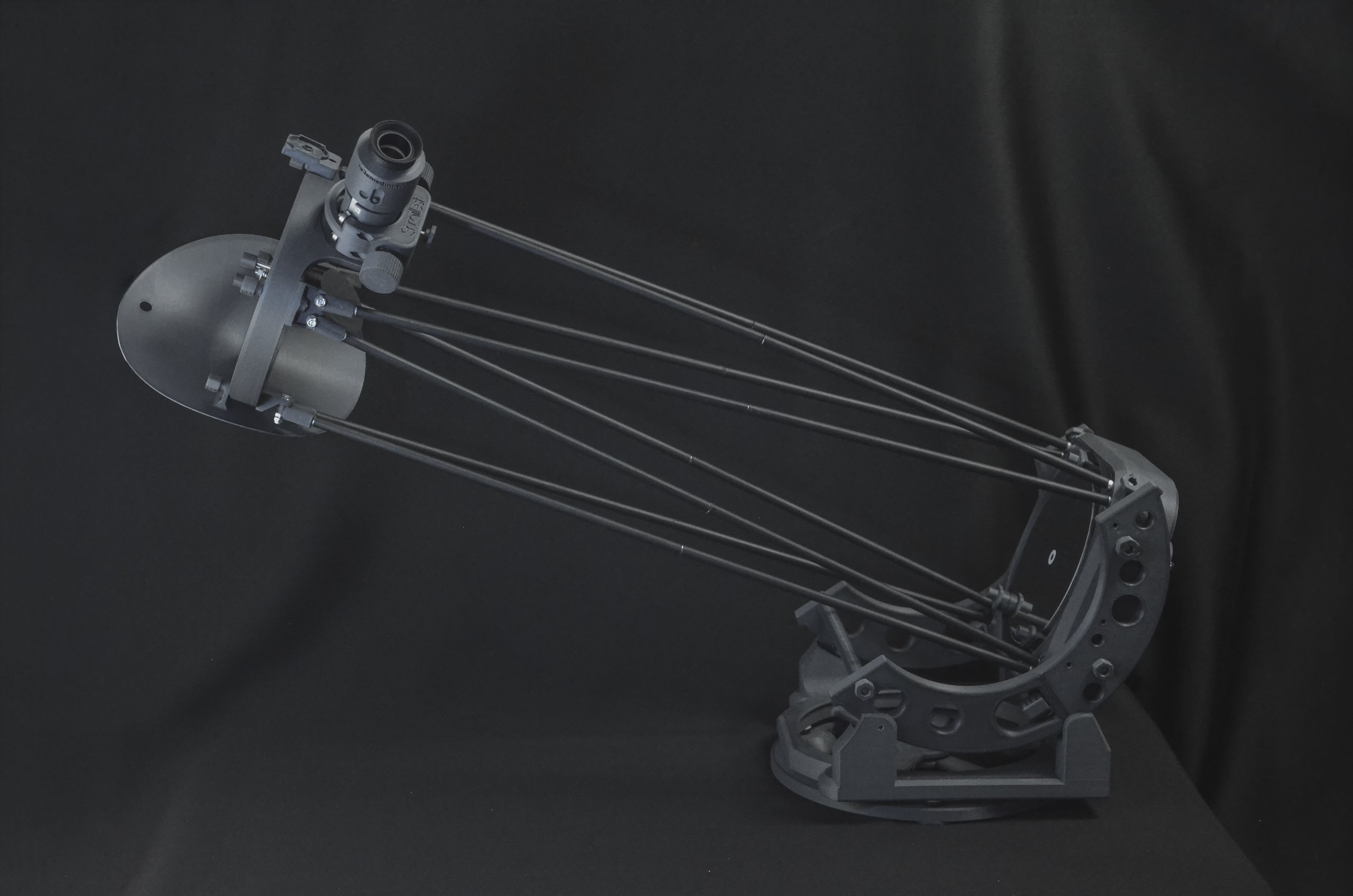
Our recommendation: The Smallest weighs 4kg with optics and fits in a plane’s cabin (25×25×20cm folded).
2. Aperture and optical performance
Don’t sacrifice too much performance for portability!
Common apertures:
- 70-90mm: Lunar and planetary observing, very portable
- 114-127mm: Good performance/portability compromise
- 150mm+: High performance, requires optimized design
Focal ratio (F/D):
- F/4 to F/5: Ideal for deep sky, compact
- F/6 to F/8: Versatile for planetary and deep sky
- F/10+: Specialized for planetary, bulkier
3. Telescope type
Newtonian (Reflector)
Advantages:
- Excellent value for money
- Good aperture for contained weight
- No chromatic aberration
Drawbacks:
- Requires collimation
- Generally longer
Example: 150/750 Newtonian (F/5) = 87cm long but collapsible
Refractor
Advantages:
- No maintenance
- High-contrast image
- Compact at small apertures
Drawbacks:
- Expensive at large apertures
- Chromatic aberration (except APO models)
Schmidt-Cassegrain / Maksutov
Advantages:
- Very compact (short tube)
- Versatile
Drawbacks:
- Expensive
- Long cool-down time
- Heavy at large apertures
4. The mount
For portability, favor:
Alt-azimuth mount:
- Simpler and lighter
- Quick setup
- Sufficient for visual observing
Dobsonian:
- Excellent for a portable Newtonian
- Very stable
- Budget-friendly
Our solution: The Smallest uses an ultra-compact, built-in Dobsonian base, with no tools needed for setup.
5. Setup time
An often overlooked but essential criterion!
- Under 5 minutes: Excellent
- 5-10 minutes: Acceptable
- Over 10 minutes: Discouraging for frequent use
A complicated setup discourages spontaneous observing sessions.
Innovations in portable telescopes
3D printing is revolutionizing nomadic astronomy
3D printing makes it possible to create structures that are:
- 30% lighter than traditional aluminum
- Perfectly fitted to the optics
- Modular and repairable
- Customizable to your needs
Modern materials like carbon-fiber-reinforced PETG offer:
- Rigidity comparable to metal
- Resistance to temperature swings
- Manufacturing precision down to the micron
Examples of innovative portable telescopes
The Smallest (see the product page):
- The first 150/750 Newtonian that fits in a plane’s cabin
- Modular 3D-printed structure
- Assembles in 4 minutes with no tools
- Weight: 4kg all included
Buying guide by profile
Beginner in portable astronomy
Budget: €200-400 Recommendation: 70-80mm refractor or 114mm Dobsonian Priority: Ease of use
Experienced amateur traveler
Budget: €400-800 Recommendation: Portable 130-150mm Newtonian or 127mm Maksutov Priority: Performance/portability compromise
Expert seeking extreme mobility
Budget: €800+ Recommendation: Optimized portable 150-200mm Newtonian, 80-100mm APO Priority: Maximum performance in a compact format
Checklist before buying
✅ Transport:
- Weight you can comfortably carry
- Fits in your vehicle/luggage
- Adequate protection included
✅ Performance:
- Aperture sufficient for your favorite objects
- Verified optical quality
- Focal ratio suited to your uses
✅ Practicality:
- Quick, simple setup
- Accessories included (finder, eyepieces)
- Clear documentation
✅ Durability:
- Sturdy materials
- Manufacturer warranty
- Spare parts available
Essential accessories for nomadic astronomy
- Suitable carrying bag (padded, weatherproof)
- Red headlamp (preserves night vision)
- Mobile app (sky maps: Stellarium, SkySafari)
- Compact eyepieces (avoid heavy, bulky Plössls)
- Cheshire or collimation laser (for Newtonians)
Maintenance tips while traveling
- Protect the optics with caps
- Avoid impacts (padded bag mandatory)
- Check collimation after every transport
- Clean gently (blower + microfiber)
- Store somewhere dry to avoid mold
The best destinations for portable astronomy
In France
- Pic du Midi (Pyrenees): Exceptional sky
- Valensole Plateau (Alps): Lavender fields under the stars
- Île de Ré: Coastal sky
- Vercors: Dark sky reserve
In Europe
- Canary Islands (Spain): Favorable latitude
- Swiss Alps: Altitude and clarity
- Iceland: Northern lights
Conclusion: Does the ideal portable telescope exist?
The perfect portable telescope doesn’t exist universally, but it does exist for your specific use.
Ask yourself the right questions:
- Where will I mainly be observing?
- What weight can I comfortably carry?
- What budget can I allocate?
- Which celestial objects interest me?
For serious nomadic astronomy, an optimized 150mm Newtonian offers the best performance/portability compromise. The innovation of 3D-printed structures now makes possible instruments that were once unthinkable in a portable form.
Ready to get into nomadic astronomy? Discover our range of portable telescopes or contact us for personalized advice.
Keywords: portable telescope, travel telescope, nomadic astronomy, choosing a telescope, portable newton, compact telescope, 3d printed astronomy, smallest telescope