3D Printing Is Revolutionizing Amateur Astronomy: Complete 2026 Guide
Short answer: 3D printing now makes it possible to build complete telescopes (structure, mount, focuser) in carbon-fiber-reinforced PETG, 30% lighter than aluminum, for a material cost of just €20 to €50. It also puts repairs and custom accessories within reach of any amateur, something previously out of reach without a workshop.
3D printing is radically transforming the world of amateur astronomy. What seemed impossible ten years ago is now a reality: building a complete telescope or custom astronomy accessories from home.
What is 3D printing applied to astronomy?
The fundamentals of 3D printing
3D printing (additive manufacturing) builds objects layer by layer from a digital model. For astronomy, this technology makes it possible to create:
- Complete telescope structures
- Optics mounts, precise to the micron
- Custom accessories (focusers, finder scopes)
- Replacement parts on demand
- Custom modifications for existing gear
Why 3D printing changes everything in astronomy
Before 3D printing:
- Standardized instruments only
- Modifications impossible without a workshop
- Spare parts expensive and rare
- Very long manufacturing times
- Prohibitive costs for custom work
With 3D printing:
- Total customization to your needs
- Speed: parts in a few hours
- Savings: material cost only
- Iteration: continuous improvement
- Easy, fast repairs
Game-changing materials for astronomy
PETG: The star material
PETG (Polyethylene Terephthalate Glycol) has become the reference:
Advantages:
- Resistant to temperature swings (-20°C to +60°C)
- Rigid enough for load-bearing structures
- Easy to print (little warping)
- Decent UV resistance
- Affordable price
Astronomical applications:
- Telescope tubes
- Alt-azimuth mounts
- Focusers
- Accessory mounts
Carbon-fiber-reinforced PETG: The real revolution
Adding carbon fiber to PETG multiplies its performance:
Characteristics:
- 30% more rigid than standard PETG
- 20% lighter than aluminum at equal rigidity
- Excellent dimensional stability
- Superior stress resistance
Our use case: The Smallest uses exclusively carbon-reinforced PETG for:
- The telescope’s main structure
- Optics mounts (stable collimation)
- Dobsonian base (maximum rigidity)
ABS and ASA for outdoor use
ABS (Acrylonitrile Butadiene Styrene):
- Very mechanically resistant
- Handles cold well
- Requires an enclosed, heated printer
ASA (an alternative to ABS):
- Excellent UV resistance
- Ideal for parts exposed outdoors
- Long-lasting outdoors
Other specialized materials
Nylon (PA): For parts subject to friction TPU (flexible): Gaskets, dampers PLA: Prototyping only (heat sensitive)
Real-world applications in amateur astronomy
1. Complete 3D-printed telescopes
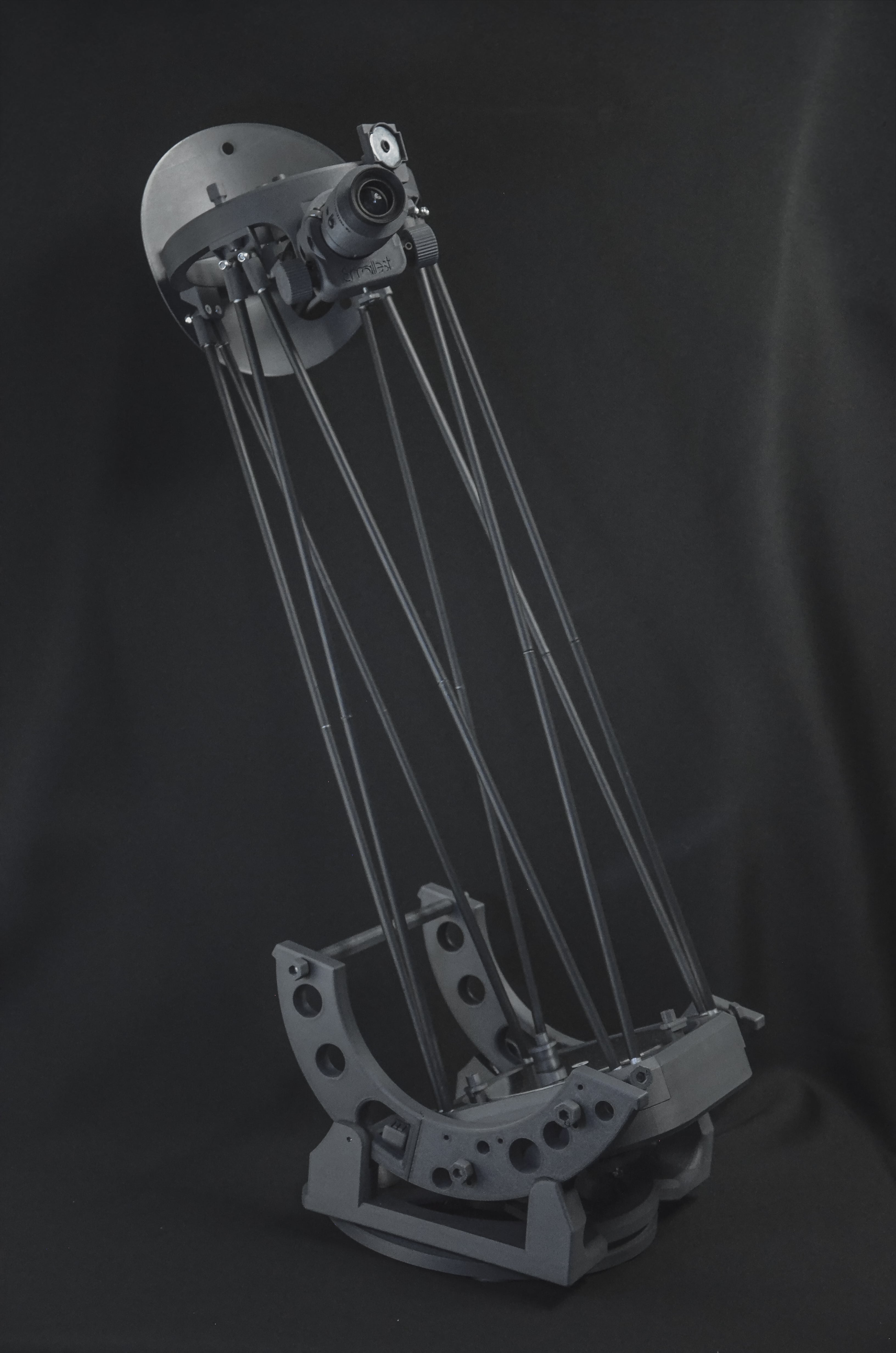
Portable Newtonian: the Smallest case study
The Smallest telescope is a perfect illustration of the potential:
Features:
- Fully functional 150/750 Newtonian
- 100% 3D-printed structure
- Weight: 4kg (vs. 8-10kg for a traditional model)
- Fits in a plane’s cabin
- Assembles in 4 minutes with no tools
Technical innovations:
- Printed clip-lock system
- Built-in collimation (adjustment screws)
- Total modularity (quick optics swaps)
- Ultra-compact folding Dobsonian base
Advantages over a traditional telescope
Lightness:
- Topologically optimized structure
- Removal of non-structural material
- Result: typically -40% weight
Modularity:
- Fully disassemblable
- Upgrade piece by piece
- Infinite customization
Price:
- Low material cost (€50-100 for a 150mm Newtonian)
- No complex tooling
- Profitable even in single-unit production
2. 3D-printed astronomy accessories
Custom focusers
Problem solved: Fitting a 2” focuser onto a 1.25” telescope
3D-printed solution:
- Custom modeling
- Printed in PETG
- Cost: €5-10 vs. €50-100 commercially
Finder scopes and viewfinders
Printed red dot finder:
- Mount specific to your tube
- Integrated LED
- Custom fit
Straight-through finder:
- Printed tube
- Dovetail mount
- Micrometric adjustment
Eyepiece and accessory mounts
- Custom storage cases
- Custom wall mounts
- Eyepiece trays with fitted compartments
- Adapters for specific uses (photography, cameras, etc.)
3. Modifications and upgrades
Upgrading existing telescopes
Common examples:
- Replacing fragile plastic with reinforced PETG
- Adding a mounting system for accessories
- Creating custom adapters for camera gear
- Improving the focuser (gear reduction, precision)
Practical case: a traditional Dobsonian
Finder scope upgrade:
- Specific printed mount
- Better ergonomics
- Easier adjustment
- Near-zero cost
Accessory tray:
- Mounts on the tube
- Compartments for 4-6 eyepieces
- Built-in filter holder
- Red light mount
4. Collimation tools
Printed Cheshire
The Cheshire is the perfect tool to print:
Advantages:
- Cost: €15 printed vs. €40-60 commercially
- Same precision
- Customizable (length, diameter)
- Unbreakable (flexible PETG)
Printed laser support:
- Perfect laser centering
- 1.25” or 2” mount
- Fine adjustment possible
Designing your own astronomy parts
3D modeling software
For beginners
Tinkercad (free, online):
- Simple interface
- Perfect for basic parts
- Quick to learn
Fusion 360 (free for personal use):
- Professional yet accessible
- Precise measurements
- Many tutorials
For advanced users
OpenSCAD:
- Programmatic shape design
- Ideal for parametric parts
- Open source
Blender:
- Complex shapes
- Free and powerful
- Steeper learning curve
Design rules for astronomy
Dimensional precision:
- Tolerance of ±0.1mm minimum
- Printer calibration is essential
- Test-fit before final production
Mechanical strength:
- Minimum thickness of 2-3mm for PETG
- Reinforcements at stress points
- Print orientation is crucial
Assembly:
- Plan for functional clearance (0.2-0.3mm)
- Avoid complex supports
- Think about assembly/disassembly
3D printing and optics: limits and possibilities
Can you 3D print mirrors?
No, but… perfect optics mounts, yes!
Why you can’t print mirrors:
- Insufficient surface finish (roughness)
- Sub-micron precision required
- Aluminizing isn’t possible
What is possible:
- Ultra-precise mirror cells
- Adjustable secondary mirror mounts
- Perfectly cylindrical optical tubes
- Built-in collimation system
The revolution: ultra-precise structures
3D printing excels at:
- Optical positioning: tolerances down to 0.05mm possible
- Easier collimation: built-in adjustment screws
- Stability: carbon PETG doesn’t deform
Result: stable collimation over the long term, even after being transported.
The economics of 3D printing in astronomy
Real costs
3D printer:
- Entry-level: €200-300 (Ender 3, Artillery)
- Mid-range: €400-600 (Prusa Mini, Bambu Lab)
- High-end: €800+ (Prusa MK4, Bambu X1)
Consumables:
- Standard PETG: €20-25/kg
- Carbon PETG: €35-50/kg
- 1kg = about 400m of filament
Example: a 150mm Newtonian telescope:
- Full structure: ~500g carbon PETG = €17
- 20h of printing
- Electricity: ~€2
Total structure cost: ~€20 (vs. €200-400 commercially)
Profitability
Break-even point:
- Printer pays for itself after 3-5 significant parts
- Or 10-15 accessories
- Considerable long-term savings
Value beyond price:
- Customization otherwise impossible
- Parts unique to your needs
- The satisfaction of building your own instrument
3D printing services for astronomy
Getting things printed without owning a printer
Options:
- Online services (Sculpteo, 3DHubs)
- Local FabLabs
- Independent makers
- Our service at La 3ème dimension
Advantages:
- No equipment investment
- Professional quality
- Advice and expertise
- Guaranteed results
Our approach:
- Custom design based on your needs
- Optimized carbon PETG printing
- Finishing and assembly
- Technical support included
The future of 3D printing in astronomy
Emerging trends
Multi-material printing:
- Complex composite structures
- Direct electronics integration
- Flexible and rigid parts in one piece
Metal printing:
- Prices steadily falling
- Precision equivalent to machining
- High-performance applications
Artificial intelligence:
- Automatic topology optimization
- Optimal design generation
- Maximum weight reduction
Toward fully personalized telescopes
Future vision:
- A telescope adapted to your exact size
- Perfect ergonomics for your use
- Performance optimized for your favorite objects
- Economically viable single-unit production
Community and sharing
Open-source 3D files
Resources:
- Thingiverse: Many astro projects
- Printables: Quality models
- Cults3D: Premium designs
- GitHub: OpenSCAD projects
Contributing:
- Share your creations
- Improve existing designs
- Documentation is essential
Joining the community
- Forums: Astrosurf, Webastro (3D printing sections), Cloudy Nights
- Facebook groups: “Astronomy and 3D Printing”
- Discord: Astronomy maker servers
- Meetups: Star parties, maker faires
Conclusion: 3D printing, the democratization of astronomy
3D printing is not just a passing trend in astronomy. It’s a permanent revolution that:
✅ Democratizes access to high-performance equipment ✅ Personalizes every instrument to its user ✅ Innovates with designs impossible in traditional manufacturing ✅ Lightens equipment drastically (nomadic astronomy) ✅ Repairs existing gear easily ✅ Educates through understanding your instrument
Whether you’re a maker, an amateur astronomer, or curious about technology, 3D printing opens up an endless field of possibilities.
Ready to take the leap?
➡️ Discover our 3D-printed creations ➡️ Order a custom project ➡️ Follow our tutorials on our blog
Keywords: 3d printed astronomy, 3d printed telescope, additive manufacturing, PETG astronomy, DIY astronomy accessories, astronomy maker, telescope innovation, 3D printing telescope