Learning by building
Ask a child how a refracting telescope works, and they’ll shrug. Hand them the parts and let them work out where the light travels, and ten minutes later they’ll explain it back to you. That difference is what guided the design of the Lumi, our educational refractor.
Understanding by building, not by reading
The idea isn’t new: we remember what we’ve handled far better than what we’ve read. In education, this is often called learning by doing: understanding a mechanism by building it, rather than following a top-down explanation. A lecture on optics can stay abstract for years. Screwing a lens into a tube yourself, then watching the light converge into an eyepiece, is something you don’t forget.
It’s a principle I sum up like this: good design shouldn’t need explaining, it should make sense the moment you hold it. The Lumi is the clearest example of that philosophy in everything I design.
How the Lumi applies this principle
In practice, the Lumi doesn’t ship with a long manual to read before you start. It relies on a few simple choices:
- Modular design: each part (lens cell, baffle, tube, eyepiece holder, star diagonal) has a visible optical function and only one way to fit together, so mistakes are hard to make without needing to check a manual at every step.
- Progressive assembly: you build the instrument in the same order light actually travels through it, from the objective lens to the eye. The build itself tells the story of the optical path.
- Immediate observation: once assembled, the Lumi lets you observe the Moon, star clusters or bright galaxies right away. The theory gets confirmed instantly, through the eyepiece.
- No prior experience needed: it’s designed for a genuine beginner, to be built as a family with an adult, with no optics knowledge required to start.
What it changes for families
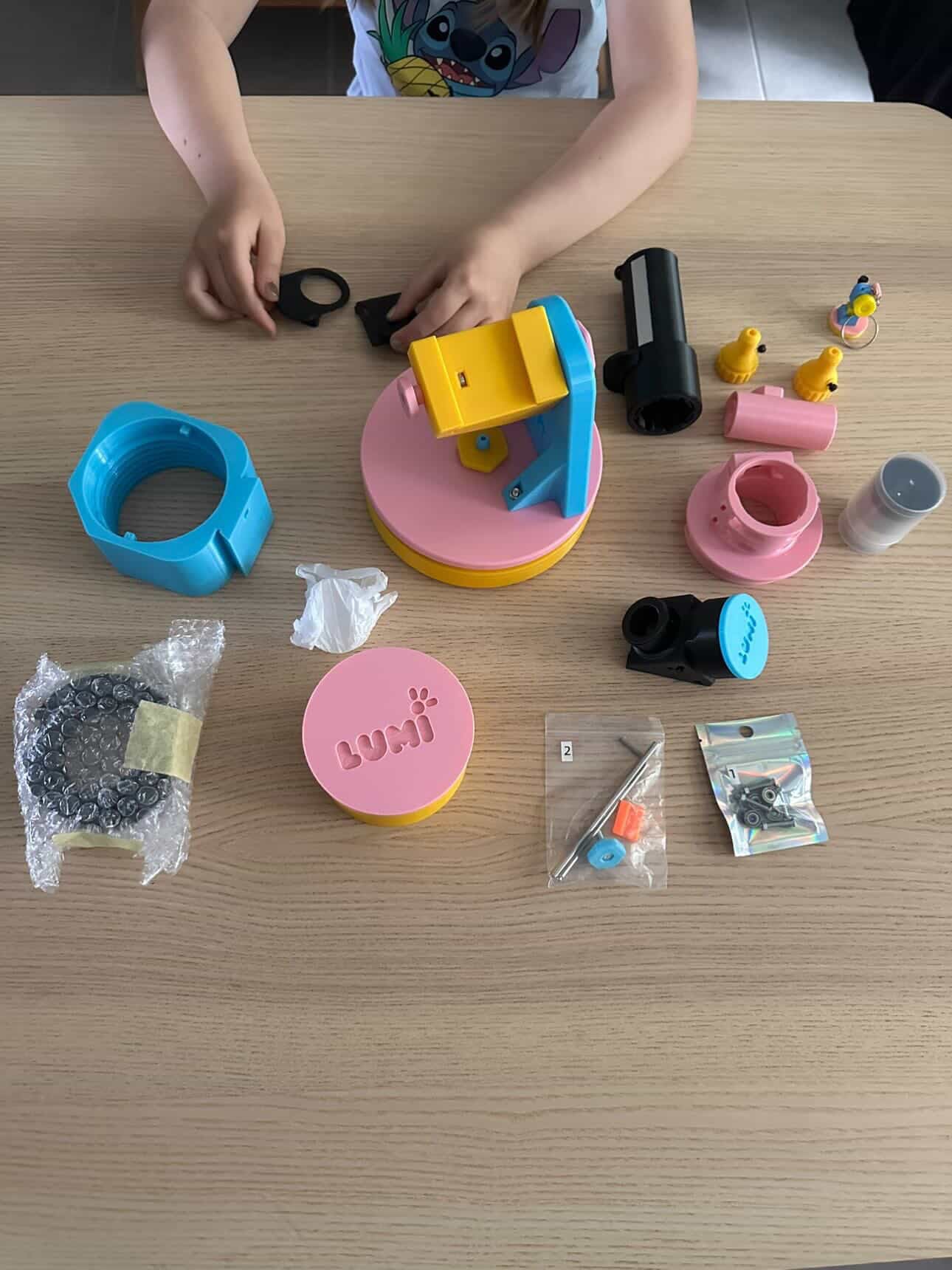
It’s the feedback from families that confirms this approach works. One mother recently wrote that building the Lumi with her 8-year-old daughter was “a real moment of sharing,” where the telescope’s workings became easy to understand while assembling it. It’s not a toy you unwrap and forget: it’s something you build together, one evening, before heading out to observe the sky the next night.
That’s exactly the goal: for the Lumi to be a doorway into astronomy with no technical barrier, and for the build itself to be as instructive as the observing session that follows.
A philosophy beyond the Lumi
This approach to learning by building isn’t limited to this one instrument. You’ll find it in the workshops we run at events like Nuit des Étoiles or astronomy festivals, where both kids and adults assemble their own telescope before using it. It’s also the logic behind the Smallest, designed to stay easy to understand and repair long after the initial build.
If you’re looking for a concrete way to introduce a child (or a curious adult) to astronomy without a theory class first, the Lumi remains the best entry point we’ve designed for that.